VIAJES FOTOS Y COMIDA DE BERNARDO SABISKY
Por: Aidan White – Presidente y fundador de la Red de Periodismo Ético y Bernardo Sabisky miembro de EJN
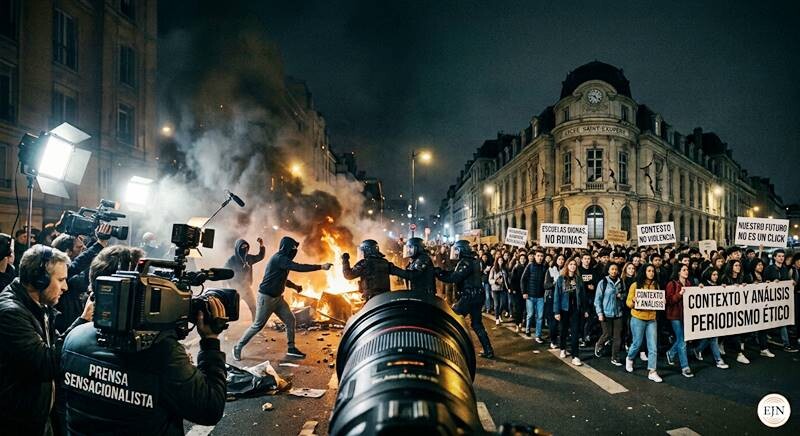
Las protestas estudiantiles en Francia abren una discusión que también alcanza al periodismo: cómo informar sobre los enfrentamientos sin dejar fuera las razones que llevaron a los jóvenes a movilizarse. Mostrar lo que ocurre en la calle es necesario. Explicar por qué ocurre, también.
El reclamo comenzó en septiembre en el instituto Saint-Exupéry, en las afueras de París, y se extendió a otros establecimientos. La falta de docentes y recursos educativos estuvo en el origen de una movilización que después incorporó un malestar social más amplio.
Detrás de los enfrentamientos
Las demandas sobre personal y recursos permiten entender el conflicto desde un lugar distinto al de las imágenes de violencia. Los incidentes forman parte de la noticia, pero no alcanzan para contarla.
Cuando una cobertura reduce una protesta a los daños, las detenciones y la respuesta policial, deja preguntas sin contestar. ¿Qué piden los estudiantes? ¿Desde cuándo? ¿Qué respuestas recibieron? Sin esos elementos, el público puede conocer el episodio más impactante y, aun así, desconocer el problema de fondo.
Eso no implica justificar agresiones ni minimizar sus consecuencias. El desafío consiste en distinguir las reivindicaciones de los manifestantes de los actos violentos, sin atribuir automáticamente a todo un movimiento las acciones de una parte.
El contexto también es noticia
La responsabilidad periodística empieza antes de publicar una imagen. Importa verificar su origen, establecer dónde y cuándo fue registrada y evaluar qué aporta a la comprensión de los hechos. Su fuerza visual no reemplaza esa tarea.
También exige escuchar a quienes reclaman, contrastar sus testimonios con las autoridades y revisar los antecedentes. Una declaración política necesita preguntas; una cifra, una fuente identificable; una escena de violencia, una explicación que no termine en la escena misma.
La competencia por la atención plantea otra dificultad. Seguir el enfoque de otros medios o la conversación de las redes puede desplazar el criterio propio. La urgencia de publicar no debería decidir, por sí sola, qué merece ser contado.
Informar para comprender
La salida no consiste en ocultar los enfrentamientos, sino en darles su lugar dentro de una historia más completa. El periodismo puede mostrar el conflicto y, al mismo tiempo, ofrecer herramientas para entenderlo. Ahí está su aporte: ayudar a que una imagen impactante sea el comienzo de una explicación, no su reemplazo.
Apoye a la EJN
Ahora necesitamos su ayuda. Este año, la EJN (Red de Periodismo Ético, por sus siglas en inglés) ha reiniciado sus actividades desde su nueva sede en Bruselas, con planes para desarrollar un programa de trabajo que promueva la ética, la buena gobernanza y la autorregulación en los medios de comunicación. Para lograrlo, necesitamos su apoyo, tanto a nivel profesional y político como financiero. No contamos con el respaldo de grandes corporaciones ni de otros grupos de interés; por ello, le pedimos que, si puede, realice una donación para contribuir a la lucha de la EJN por un periodismo ético y de calidad. Puede donar a: Ethical Journalism Network, IBAN: BE43 3632 8361 4401.
@viajesfotosycomidas #viajesfotosycomidas
https://sites.google.com/view/bernardosabisky-media-kit
Quand le sensationnalisme fait obstacle à une bonne histoire
Par Aidan White – Président et fondateur de l’Ethical Journalism Network, et Bernardo Sabisky, membre de l’EJN
Les manifestations étudiantes en France ont relancé un débat qui concerne également le journalisme : comment rendre compte des affrontements sans passer sous silence les raisons qui ont poussé les jeunes à se mobiliser. Montrer ce qui se passe dans la rue est nécessaire. Expliquer pourquoi cela se produit l’est tout autant.
La mobilisation a débuté en septembre au lycée Saint-Exupéry, en banlieue parisienne, avant de s’étendre à d’autres établissements. Le manque d’enseignants et de moyens éducatifs a été à l’origine d’un mouvement qui a ensuite cristallisé un mécontentement social plus large.
Derrière les affrontements
Les revendications portant sur les effectifs et les moyens permettent de comprendre le conflit sous un angle différent de celui des images de violence. Les incidents font partie de l’actualité, mais ils ne suffisent pas à raconter toute l’histoire.
Lorsqu’un traitement médiatique réduit une manifestation aux dégradations, aux arrestations et à la réponse policière, il laisse des questions essentielles sans réponse. Que demandent les élèves ? Depuis quand ? Quelles réponses ont-ils reçues ? Sans ces éléments, le public peut être informé de l’épisode le plus spectaculaire tout en ignorant le problème de fond.
Cela ne signifie pas qu’il faille justifier les agressions ou minimiser leurs conséquences. Le défi consiste à distinguer les revendications des manifestants des actes de violence, sans attribuer automatiquement à l’ensemble d’un mouvement les agissements d’une partie de ses participants.
Le contexte fait aussi partie de l’actualité
La responsabilité journalistique commence avant même la publication d’une image. Il est important d’en vérifier l’origine, de déterminer où et quand elle a été prise et d’évaluer ce qu’elle apporte à la compréhension des événements. Sa force visuelle ne saurait se substituer à ce travail.
Cette responsabilité implique également d’écouter ceux qui portent les revendications, de confronter leurs témoignages à ceux des autorités et d’examiner les éléments de contexte. Une déclaration politique appelle des questions ; un chiffre, une source identifiable ; une scène de violence, une explication qui ne s’arrête pas à la scène elle-même.
La course à l’attention du public soulève une autre difficulté. S’aligner sur l’angle adopté par d’autres médias ou sur les discussions qui animent les réseaux sociaux peut faire perdre de vue son propre jugement éditorial. L’urgence de publier ne devrait pas, à elle seule, déterminer ce qui mérite d’être raconté.
Informer pour faire comprendre
La solution ne consiste pas à dissimuler les affrontements, mais à leur donner leur juste place dans un récit plus complet. Le journalisme peut montrer le conflit tout en fournissant les clés nécessaires pour le comprendre. C’est là toute sa contribution : faire en sorte qu’une image marquante soit le point de départ d’une explication, et non son substitut.
Soutenez l’EJN
Nous avons aujourd’hui besoin de votre aide. Cette année, l’EJN (Ethical Journalism Network) a repris ses activités depuis son nouveau siège à Bruxelles, avec pour ambition de mettre en place un programme de travail visant à promouvoir l’éthique, la bonne gouvernance et l’autorégulation dans les médias.
Pour y parvenir, nous avons besoin de votre soutien, tant sur les plans professionnel et politique que financier. Nous ne bénéficions du soutien ni de grandes entreprises ni d’autres groupes d’intérêt. C’est pourquoi nous vous invitons, si vous le pouvez, à faire un don afin de contribuer au combat de l’EJN en faveur d’un journalisme éthique et de qualité.
Vous pouvez effectuer votre don à l’ordre de :
Ethical Journalism Network
IBAN : BE43 3632 8361 4401
@viajesfotosycomidas #viajesfotosycomidas
https://sites.google.com/view/bernardosabisky-media-kit
When Sensationalism Gets in the Way of a Good Story
By Aidan White – President and Founder of the Ethical Journalism Network, and Bernardo Sabisky, EJN member
Student protests in France have sparked a debate that also concerns journalism: how to report on clashes without overlooking the reasons that prompted young people to take to the streets. Showing what is happening on the ground is essential. Explaining why it is happening is just as important.
The protests began in September at Saint-Exupéry High School, on the outskirts of Paris, and spread to other schools. A shortage of teachers and educational resources initially sparked the mobilization, which later came to reflect broader social discontent.
Behind the clashes
Demands for more staff and resources offer a way of understanding the conflict that goes beyond images of violence. Incidents are part of the story, but they are not enough to tell it.
When news coverage reduces a protest to property damage, arrests and the police response, it leaves important questions unanswered. What are the students demanding? How long have they been making these demands? What responses have they received? Without this information, the public may learn about the most dramatic events while remaining unaware of the underlying problem.
This does not mean justifying assaults or downplaying their consequences. The challenge is to distinguish protesters’ demands from acts of violence, without automatically attributing the actions of some participants to an entire movement.
Context is news, too
Journalistic responsibility begins before an image is published. It is important to verify its origin, establish where and when it was taken, and assess what it contributes to understanding the events. Its visual impact cannot replace that work.
It also means listening to those making the demands, cross-checking their accounts with the authorities and examining the background to the dispute. A political statement calls for questions; a statistic requires an identifiable source; and a scene of violence needs an explanation that goes beyond the images themselves.
The competition for public attention presents another challenge. Following other media outlets’ editorial angles or the conversation on social media can undermine independent judgment. The pressure to publish quickly should not, in itself, determine what deserves to be reported.
Reporting to foster understanding
The answer is not to conceal the clashes, but to place them within a broader, more complete account of events. Journalism can show the conflict while also providing the tools to understand it. That is its contribution: helping ensure that a powerful image becomes the starting point for an explanation, not a substitute for one.
Support the EJN
We need your help now. This year, the EJN (Ethical Journalism Network) has resumed its activities from its new headquarters in Brussels, with plans to develop a programme of work promoting ethics, good governance and self-regulation in the media.
To make this possible, we need your support, professionally, politically and financially. We do not have the backing of major corporations or other interest groups. We therefore ask you, if you are able, to make a donation to support the EJN’s work in the fight for ethical, high-quality journalism.
Donations can be made to:
Ethical Journalism Network
IBAN: BE43 3632 8361 4401
@viajesfotosycomidas #viajesfotosycomidas
https://sites.google.com/view/bernardosabisky-media-kit
当耸人听闻的报道掩盖了一个好故事
作者:Aidan White——道德新闻网络(Ethical Journalism Network)主席兼创始人;Bernardo Sabisky——道德新闻网络成员
法国学生抗议活动引发了一场同样关乎新闻业的讨论:如何报道冲突事件,同时又不忽略促使年轻人走上街头的原因。展现街头正在发生的事情固然重要,解释事情为何发生同样不可或缺。
这场抗议始于9月,最初发生在巴黎郊区的圣埃克苏佩里中学(Saint-Exupéry),随后蔓延至其他学校。教师短缺和教育资源不足是此次学生动员的最初原因,而这场运动后来也逐渐反映出更广泛的社会不满情绪。
冲突背后的原因
有关教职人员和教育资源的诉求,为理解这场冲突提供了一个不同于暴力画面的视角。冲突事件是新闻的一部分,但仅凭这些事件不足以讲述整个故事。
当新闻报道将一场抗议简化为财产损失、逮捕行动和警方应对时,许多重要问题便得不到回答。学生们究竟在要求什么?这些诉求已经持续了多久?他们得到了怎样的回应?缺少这些信息,公众或许能够了解到最引人注目的事件,却仍然无法认识到问题的根源。
这并不意味着要为暴力行为辩护,也不意味着淡化其后果。真正的挑战在于,将抗议者的诉求与暴力行为区分开来,而不是将部分参与者的行为自动归咎于整个运动。
背景同样是新闻的重要组成部分
新闻工作者的责任,从发布一张图片之前就已经开始。核实图片来源、确认拍摄的时间和地点,并评估它对理解事件究竟有何帮助,这些都至关重要。视觉冲击力不能取代这些工作。
这也意味着,记者必须倾听提出诉求者的声音,将他们的陈述与官方说法进行交叉核实,并审视事件的背景。一项政治声明需要追问;一个统计数字需要有明确可查的来源;一幕暴力场景则需要得到进一步解释,而不能让报道止步于画面本身。
争夺公众注意力的竞争还带来了另一重挑战。追随其他媒体的报道角度,或迎合社交媒体上的讨论,可能使新闻机构失去独立判断。发布新闻的紧迫性不应成为决定报道内容的唯一标准。
以报道促进理解
解决之道不是掩盖冲突,而是将其置于一个更加完整的叙事之中,给予其恰当的位置。新闻业既可以呈现冲突,也可以同时为公众提供理解冲突的必要工具。
这正是新闻业的价值所在:让一幅具有冲击力的画面成为解释事件的起点,而不是取代解释本身。
支持道德新闻网络(EJN)
现在,我们需要您的帮助。今年,道德新闻网络(EJN,Ethical Journalism Network)已从其位于布鲁塞尔的新总部重新启动各项工作,并计划制定一项工作方案,推动媒体领域的新闻伦理、良好治理和行业自律。
为了实现这一目标,我们需要您在专业、政治和资金等方面给予支持。我们没有大型企业或其他利益集团的资助。因此,我们诚挚地邀请您在力所能及的情况下捐款,支持EJN为推动道德、优质新闻事业所作的努力。
捐款账户信息:
账户名称: Ethical Journalism Network
IBAN(国际银行账号): BE43 3632 8361 4401
@viajesfotosycomidas #viajesfotosycomidas
https://sites.google.com/view/bernardosabisky-media-kit
जब सनसनीखेज़ पत्रकारिता एक अच्छी कहानी के आड़े आ जाती है
लेखक: एडन व्हाइट (Aidan White) — एथिकल जर्नलिज़्म नेटवर्क (Ethical Journalism Network) के अध्यक्ष एवं संस्थापक, और बर्नार्डो साबिस्की (Bernardo Sabisky) — EJN के सदस्य
फ्रांस में छात्रों के विरोध प्रदर्शनों ने एक ऐसी बहस को जन्म दिया है, जिसका संबंध पत्रकारिता से भी है: झड़पों की रिपोर्टिंग करते समय उन कारणों को कैसे नज़रअंदाज़ न किया जाए, जिन्होंने युवाओं को आंदोलन के लिए सड़कों पर उतरने के लिए प्रेरित किया। सड़कों पर क्या हो रहा है, यह दिखाना ज़रूरी है। लेकिन ऐसा क्यों हो रहा है, यह समझाना भी उतना ही महत्वपूर्ण है।
यह विरोध प्रदर्शन सितंबर में पेरिस के बाहरी इलाके में स्थित सेंट-एक्ज़ूपेरी हाई स्कूल (Saint-Exupéry) से शुरू हुआ और धीरे-धीरे अन्य शिक्षण संस्थानों तक फैल गया। शिक्षकों और शैक्षिक संसाधनों की कमी इस आंदोलन की शुरुआती वजह थी, लेकिन बाद में इसमें व्यापक सामाजिक असंतोष भी शामिल हो गया।
झड़पों के पीछे की वजहें
शिक्षकों की संख्या और शैक्षिक संसाधनों से जुड़ी मांगें इस संघर्ष को हिंसा की तस्वीरों से अलग एक दृष्टिकोण से समझने का अवसर देती हैं। हिंसक घटनाएं खबर का हिस्सा हैं, लेकिन केवल उन्हीं के आधार पर पूरी कहानी नहीं बताई जा सकती।
जब मीडिया कवरेज किसी विरोध प्रदर्शन को केवल संपत्ति को हुए नुकसान, गिरफ्तारियों और पुलिस की कार्रवाई तक सीमित कर देता है, तो कई महत्वपूर्ण सवाल अनुत्तरित रह जाते हैं। छात्र आखिर क्या मांग रहे हैं? उनकी मांगें कब से जारी हैं? उन्हें क्या जवाब मिले हैं? इन तथ्यों के बिना जनता सबसे नाटकीय घटनाओं से तो परिचित हो सकती है, लेकिन समस्या की असली जड़ से अनजान रह सकती है।
इसका अर्थ यह नहीं है कि हिंसक हमलों को उचित ठहराया जाए या उनके परिणामों को कम करके आंका जाए। चुनौती यह है कि प्रदर्शनकारियों की मांगों और हिंसक कृत्यों के बीच स्पष्ट अंतर किया जाए, ताकि कुछ लोगों की कार्रवाइयों के लिए पूरे आंदोलन को स्वतः जिम्मेदार न ठहराया जाए।
संदर्भ भी खबर का हिस्सा है
पत्रकारिता की जिम्मेदारी किसी तस्वीर को प्रकाशित करने से पहले ही शुरू हो जाती है। यह सत्यापित करना महत्वपूर्ण है कि तस्वीर कहां से आई है, उसे कहां और कब लिया गया था तथा घटनाओं को समझने में उसका क्या योगदान है। तस्वीर का दृश्य प्रभाव इस जरूरी काम का विकल्प नहीं हो सकता।
इस जिम्मेदारी में मांग उठाने वालों की बात सुनना, उनके बयानों का अधिकारियों के पक्ष से मिलान करना और घटनाओं की पृष्ठभूमि की पड़ताल करना भी शामिल है। किसी राजनीतिक बयान पर सवाल उठाए जाने चाहिए; किसी आंकड़े का स्पष्ट और पहचाना जा सकने वाला स्रोत होना चाहिए; और हिंसा के किसी दृश्य के साथ ऐसी व्याख्या होनी चाहिए, जो केवल उस दृश्य तक सीमित न रह जाए।
जनता का ध्यान आकर्षित करने की होड़ एक और चुनौती पैदा करती है। दूसरे मीडिया संस्थानों के दृष्टिकोण या सोशल मीडिया पर चल रही चर्चाओं का अनुसरण करने से पत्रकारिता का स्वतंत्र विवेक प्रभावित हो सकता है। खबर प्रकाशित करने की जल्दबाजी अपने आप में यह तय नहीं करनी चाहिए कि क्या खबर के योग्य है।
समझ विकसित करने के लिए पत्रकारिता
समाधान झड़पों को छिपाने में नहीं, बल्कि उन्हें घटनाओं की अधिक व्यापक और संपूर्ण कहानी में उनका उचित स्थान देने में है। पत्रकारिता संघर्ष को सामने ला सकती है और साथ ही उसे समझने के लिए आवश्यक साधन भी उपलब्ध करा सकती है।
यही पत्रकारिता का वास्तविक योगदान है: एक प्रभावशाली तस्वीर को किसी घटना की व्याख्या की शुरुआत बनाना, न कि उस व्याख्या का विकल्प।
EJN का समर्थन करें
अब हमें आपके सहयोग की आवश्यकता है। इस वर्ष EJN (एथिकल जर्नलिज़्म नेटवर्क) ने ब्रुसेल्स स्थित अपने नए मुख्यालय से अपनी गतिविधियां फिर से शुरू की हैं। संगठन की योजना एक ऐसे कार्य कार्यक्रम को विकसित करने की है, जो मीडिया में नैतिकता, सुशासन और स्व-नियमन को बढ़ावा दे।
इस लक्ष्य को हासिल करने के लिए हमें पेशेवर, राजनीतिक और आर्थिक—तीनों स्तरों पर आपके समर्थन की आवश्यकता है। हमें किसी बड़ी कंपनी या अन्य हित समूहों का वित्तीय सहयोग प्राप्त नहीं है। इसलिए हम आपसे अनुरोध करते हैं कि यदि संभव हो, तो EJN के नैतिक और गुणवत्तापूर्ण पत्रकारिता के संघर्ष में योगदान देने के लिए दान करें।
आप निम्नलिखित खाते में दान कर सकते हैं:
खाताधारक का नाम: Ethical Journalism Network
IBAN: BE43 3632 8361 4401
@viajesfotosycomidas #viajesfotosycomidas
https://sites.google.com/view/bernardosabisky-media-kit